Crescent Moon Santa: A Designer’s Review
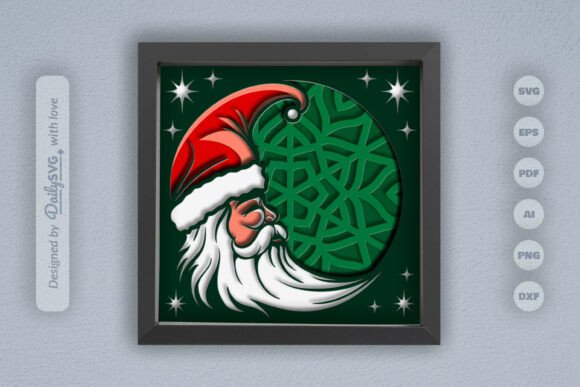
As an embroidery digitizer and product reviewer, I approach every new asset with a critical eye toward stitchability and marketability. When I first examined the Crescent Moon Santa Clause Layered Paper, my immediate thought was how this whimsical 3D SVG concept could translate into a tangible machine embroidery design. While originally crafted for smooth cutting on machines like Cricut or Silhouette, the layered aesthetic offers a unique blueprint for embroiderers looking to create depth without excessive stitch counts. For small business owners and Etsy sellers, this design bridges the gap between digital artistry and physical craftsmanship, but it requires specific technical considerations to succeed as a finished product.
Translating Paper Layers to Thread and Texture
The visual personality of the Crescent Moon Santa is undeniably nostalgic. It evokes a quiet, magical Christmas mood that differs from the loud, chaotic holiday graphics often seen in commercial markets. However, moving from a paper-cutting file to an embroidery file demands a shift in mindset. In paper crafting, layers are stacked physically; in embroidery, we must simulate this dimension through strategic stitching.
When evaluating this for a real-world project, I envision it most successfully as an applique design. Trying to replicate intricate paper layers solely with fill stitches can result in a dense, bulletproof patch that distorts fabric. Instead, use the "layered" aspect as a guide for fabric placement. The crescent moon shape provides an excellent natural frame for satin stitch borders, while Santa’s details can be rendered with lighter running stitches or contrasting fabric appliques. This adaptation preserves the delicate feel of the original 3D SVG while ensuring the stitch density remains manageable for wearable items.
Real-World Application: The Holiday Sweatshirt Test
To truly judge the viability of this design, I mentally prototyped it for a high-demand item in my shop: a unisex holiday sweatshirt. Customers currently favor vintage-inspired, soft-hand embroidery over stiff, heavy patches. Here is how the Crescent Moon Santa performs in this scenario:
- Visual Hierarchy: The curved geometry of the moon naturally cradles the chest area of a sweatshirt, making it an ideal left-chest or center-yoke placement. It avoids the "boxy" look of standard square designs.
- Fabric Interaction: On fleece or French terry, the design needs breathing room. If you adapt the paper layers into tonal thread work, ensure there is negative space between elements to prevent the fabric from puckering.
- Customer Perception: This design signals "boutique quality" rather than "mass production." It appeals to buyers seeking personalized gifts that feel heirloom-quality. The layered aesthetic suggests complexity and care, increasing the perceived value of your custom apparel.
- Production Efficiency: By utilizing the clean lines of the vector source, you can minimize jump stitches. A well-digitized version of this moon and Santa combo should run smoothly, reducing production time per unit for craft business owners.
Navigating Technical Limitations and Fabric Choices
Despite its charm, the Crescent Moon Santa Clause Layered Paper presents challenges that every professional embroiderer must respect. Not every substrate is suitable for this level of detail. I advise extreme caution when attempting this design on the following:
- Stretchy Knits and Ribbing: The circular nature of the moon can distort easily on unstable fabrics. Without proper stabilizer and potentially a topping, the curve may warp into an oval after washing.
- Small Hoop Sizes: If you are working with a 4x4 hoop, resizing this design requires vigilance. Reducing the size too much will cause the internal details of Santa’s face to merge. Always verify the minimum safe size before stitching.
- Textured Fabrics: Avoid using this on terry cloth towels or minky blankets unless you use a heavy water-soluble topping. The fine details intended to mimic paper cuts will get lost in the pile.
- Dark Fabrics: Since the original is likely designed for light paper, adapting it for black or navy garments requires rethinking contrast. White or cream thread is essential, but you may need additional underlay to prevent the dark fabric from showing through lighter stitch areas.
For caps and curved surfaces, I recommend testing first. The horizontal span of a crescent moon can be tricky on the limited flat sewing field of a hat frame. It often works better as a side accent rather than a centered front logo.
Elevating Brand Value Through Design Adaptation
For Etsy sellers and handmade shop owners, using a design like Crescent Moon Santa is about more than just filling a hoop; it is about brand consistency. This design carries a specific "cottagecore meets classic Christmas" vibe. If your shop specializes in modern minimalist or neon aesthetics, this might clash with your existing catalog. However, if you sell nursery decor, baby embroidery, or vintage-style holiday goods, this asset is a powerful addition.
The "layered paper" origin story actually serves as a marketing angle. When listing finished products, you can describe the inspiration behind the piece, highlighting the dimensional quality and artistic roots. This narrative builds buyer engagement and trust. Furthermore, because the source is a digital download crafted for precision, the lines are inherently cleaner than many hand-drawn scans, resulting in sharper printable mockups and more professional product photography.
Essential Pre-Stitch Checklist for Makers
Before you commit this design to a client project or bulk inventory run, treat it with the same rigor as any commercial embroidery asset. My standard protocol for adapting vector art to needlework includes:
- Verify Licensing: Confirm whether your purchase includes commercial rights for finished embroidered products versus digital resale. Never assume; always check the specific terms provided by the creator.
- Digitize or Convert Properly: Do not auto-digitize a complex layered SVG. Use the vector as a template to manually place satin, fill, and running stitches appropriate for textiles.
- Test on Scrap Material: Always stitch out on the exact fabric you intend to sell. A test on cotton muslin does not predict performance on ribbed knit.
- Check Thread Contrast: View your color chart in grayscale. If the layers disappear in black and white, they lack sufficient contrast for visual clarity in thread.
- Stabilizer Selection: Match your backing to the fabric weight. For this design, a medium-weight cutaway usually offers the best support for the curved moon shape on apparel.
- Mockup Validation: Create realistic digital previews showing the design on actual garment textures. This helps customers visualize the final handmade product accurately.
Final Thoughts for the Creative Entrepreneur
The Crescent Moon Santa Clause Layered Paper represents a beautiful intersection of digital crafting and traditional needle arts. Its strength lies in its silhouette and its ability to evoke emotion through simple, layered forms. For the experienced embroiderer, it is a canvas for technical creativity—challenging us to interpret paper logic through thread tension and fabric choice.
Whether you are creating a personalized gift for a loved one or stocking your small shop for the holiday rush, success comes from respecting the medium. Adapt the design to suit the textile, not the other way around. When executed with attention to stabilizer, density, and contrast, this design transforms from a digital file into a cherished keepsake that stands out in a crowded marketplace. Remember to always validate your specific machine compatibility and file formats before beginning, ensuring a smooth transition from screen to hoop.